

Developed sail technology that tilts sails like airplane wings to the left and right to move forward even in headwinds.
2022.08.01
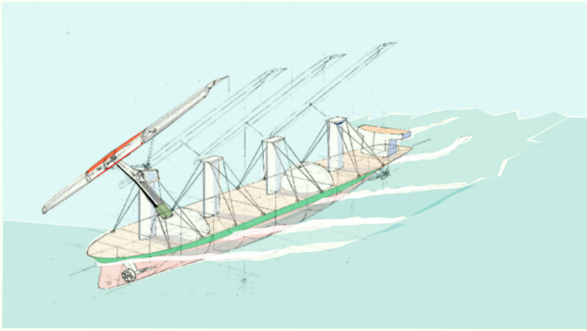
Sailing ship type wind power generation image ???? Nippon Kaiji Kyokai
Harvesting ocean energy, energy issues focus on sailboat technology
August 1, 2022
Taiyo Kogyo Corporation
(Tokyo headquarters: Setagaya-ku, Tokyo; Osaka headquarters: Yodogawa-ku, Osaka; President: Yumi Nomura; hereafter “Taiyo Kogyo”), a company involved in large-scale membrane surface structures (tent structures) and civil engineering and logistics materials, is cooperating with the Nippon Kaiji Kyokai (headquarters: Chiyoda-ku, Tokyo; Chairman: Hiroaki Sakashita; hereafter “NKKK”) to develop a sail technology that moves forward even in headwinds while tilting left and right like an airplane wing (wing section), (Headquarters: Chiyoda-ku, Tokyo; Chairman: Hiroaki Sakashita; hereinafter referred to as “NKKK”) to develop a sailing technology that moves forward even in headwinds while tilting a sail like an airplane wing (wing section) to the left or right. We have recently applied for a patent as a “Sailing Device” and will start demonstration tests on Lake Biwa in August 2022.
Envisioned sailboat-type wind power generation
The Nippon Kaiji Kyokai is developing a ship (a sailboat-type wind power generation ship) that can generate electricity by moving with the wind and using seawater to rotate its propellers. This is called an OEHV (Ocean Energy Harvest Vessel), and the goal is to establish and commercialize the technology by 2030. Unlike offshore wind power generation systems (landing or floating type), which are installed along the coast, sailing vessels can travel under their own power to distant oceans where stronger winds are blowing to generate power. Since seawater, which has a higher density than air, is used to turn the propellers of the generator, power can be generated with higher efficiency than with wind power. Without the need to build a power transmission line, the boat can generate, store, and transport its own power, and deliver energy directly to the port. According to preliminary calculations, the operation of 100 vessels can provide 10% of Japan’s total power generation.
Sail technology that moves forward even with headwinds in the wing section
The sailing technology we are developing for a sailing wind turbine can generate lift more efficiently in response to wind by using a rotating sail that tilts from side to side. Unlike a single piece of cloth, a sail with a structure similar to the wings of an airplane (wing section) is thicker and has been shown to generate higher lift. Taiyo Kogyo’s technology is used to manufacture the framework of this flexible, strong, and lightweight sail and the highly durable membrane that covers its surface.
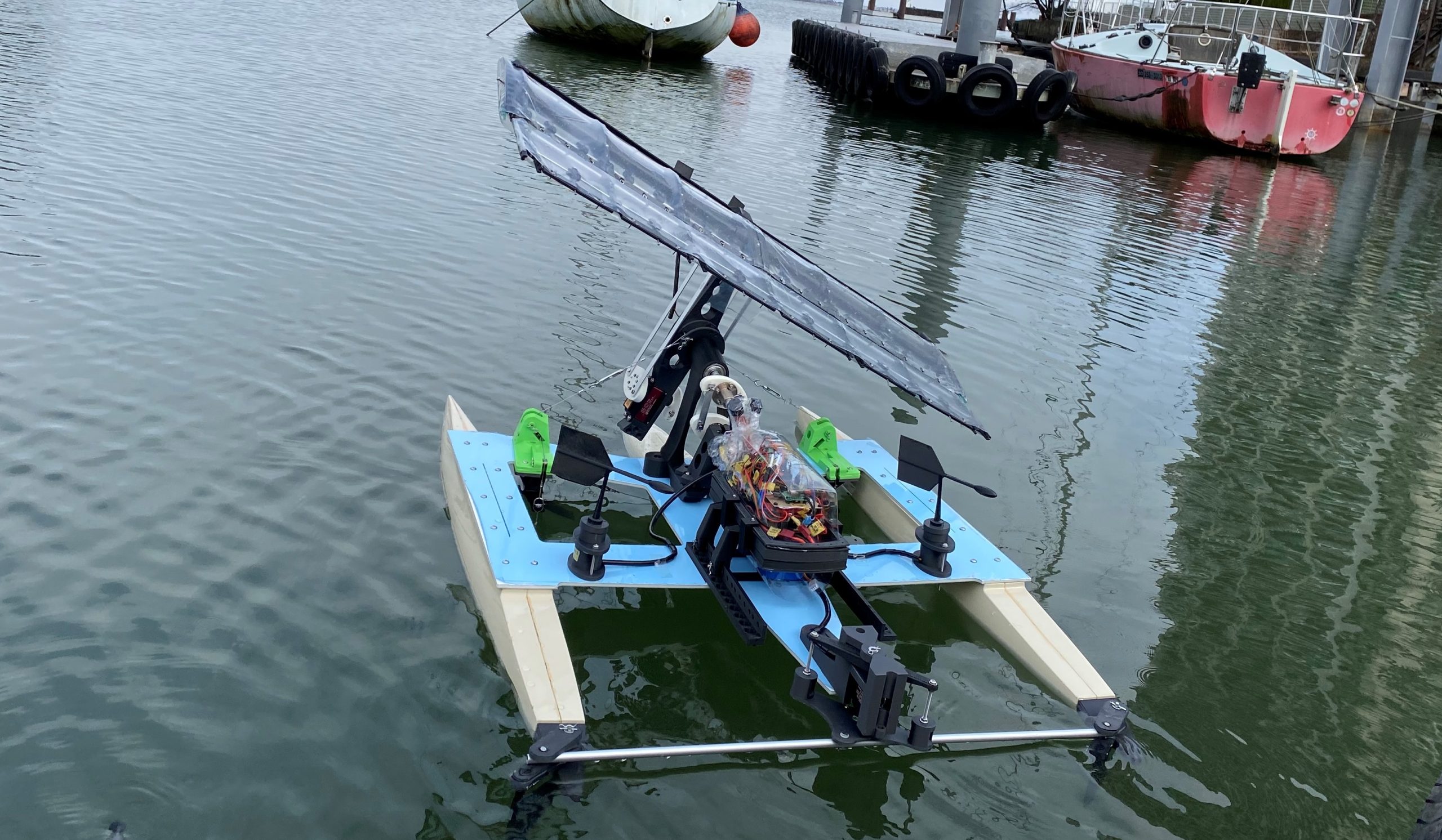
Sailing ship type wind power generation Experimental ship
In addition, the aerial wings (on the ship) and underwater wings (in the sea) work in tandem to prevent the hull from tipping over due to the force applied to the sails, and a patent application has been filed for this technology combining aerial and underwater wings. Development of the technology was initiated in March 2021 by Kaiji Kyokai and Taiyo Kogyo. In May of this year, we applied for a patent for this technology after conducting experiments on preventing tipping over by using a rotating sail in conjunction with an underwater wing. In August, Taiyo Kogyo will start demonstration tests to further improve the efficiency of power generation by acquiring power generation data, testing automatic rotation around GPS-designated points, and testing speed in accordance with the wind.
Taiyo Kogyo's Commitment to Sailing Boat Technology
Taiyo Kogyo was in charge of manufacturing sails for the sailing tanker Shin Aitoku Maru (1980), which was built due to the soaring oil prices caused by the oil shocks of the 1970s. Subsequently, as the price of crude oil stabilized, Taiyo Kogyo faced a situation in which the use of sails on merchant vessels declined significantly. However, Taiyo Kogyo continued to develop its technology to maintain its sailing technology, and in 1981, it participated in the Trans-Pacific Single-Handed Race with the “Taiyo: Fukunari Imada” and won the race. This trans-Pacific race was an advanced race that combined the most advanced weather analysis and sailing at the time, and was similar to a sailing wind power generation vessel that generates electricity by operating based on weather forecasts.
In 2017, Taiyo Kogyo developed the world’s first ETFE (polymer of ethylene and tetrafluoroethylene) sail; ETFE has been used as a building material in recent years as a material with no UV degradation, and Taiyo Kogyo’s analysis and processing technology for ETFE membrane structure was applied. By cooperating in the development of “sailboat-type wind power generation,” Taiyo Kogyo plans to take advantage of the “wind resistance” technology it has cultivated in membrane structures as a building material and develop it into a technology for “wind utilization” as a renewable energy source.
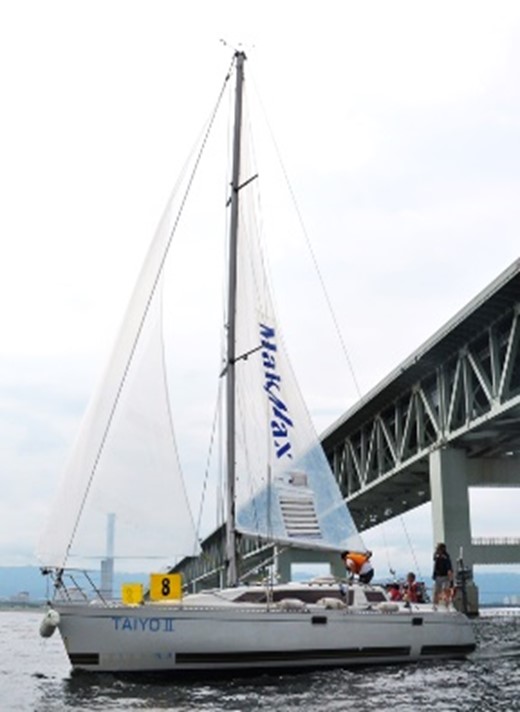
Taiyo Kogyo’s in-house club boat TAIYO II sailing under transparent ETFE sails (2017)
About Taiyo Kogyo Corporation
Taiyo Kogyo is a “leading company of membrane structures” that aims to support the safety and security of society and contribute to the realization of affluent lifestyles for people. Taking advantage of the characteristics of light and strong materials, Taiyo Kogyo is expanding its products into various construction businesses symbolized by the roofs of giant domes, as well as into civil engineering, logistics, and even the environmental field. In recent years, in particular, the company has been attracting public attention for its emergency response to the many disasters that have occurred in various regions, as well as for its medical tents used to combat the new type of coronas.
Official website: https://www.taiyokogyo.co.jp/