Domestic Sales of the “ROBAPS” Automatic Filling System Begin
Contributing to Labor Savings in Container Bag Filling Operations and Improvements to the Work Environment
2026.07.02
Taiyo Kogyo Co., Ltd. (Tokyo Headquarters: Setagaya-ku, Tokyo; Osaka Headquarters: Yodogawa-ku, Osaka; President and CEO: Yuki Nomura), a company specializing in large-scale membrane structures (tent structures) as well as civil engineering and logistics materials, has entered into an exclusive sales agreement with DYPN Co., Ltd. (Seoul, South Korea; CEO: Shin Seung-dae), and will begin domestic sales of “ROBAPS,” a system that automatically fills container bags with raw materials such as powders and pellets.The introduction of this product will help reduce the labor required for filling operations in the logistics industry and improve working conditions at filling sites. The company aims to achieve sales of 1 billion yen by fiscal year 2028.
In workplaces where dust is generated—such as manufacturing, construction, recycling, and chemical and materials-related factories—improving the working environment has become a critical management issue.At worksites where dust is handled, inhaling fine particles during work can pose health risks. Therefore, based on the Industrial Safety and Health Act and the Regulations for the Prevention of Dust-Related Diseases, various safety measures are implemented, such as installing ventilation systems and requiring the use of dust masks and personal protective equipment (PPE).While dust masks and protective clothing are essential for reducing dust exposure, the higher the level of airtightness and protective performance, the greater the physical strain on workers, which can lead to reduced work efficiency and accumulated fatigue. Particularly during the summer or in high-temperature environments, heat tends to build up, raising concerns about the risk of heatstroke.
Furthermore, due to a shrinking workforce resulting from a declining birthrate and an aging population, the manufacturing, logistics, and construction sectors continue to face chronic labor shortages. At worksites with dust-laden environments, the perception that the work involves “significant physical strain” and “harsh working conditions” can make it difficult to recruit workers; consequently, there is a growing need to improve working conditions from the perspective of securing and retaining talent.
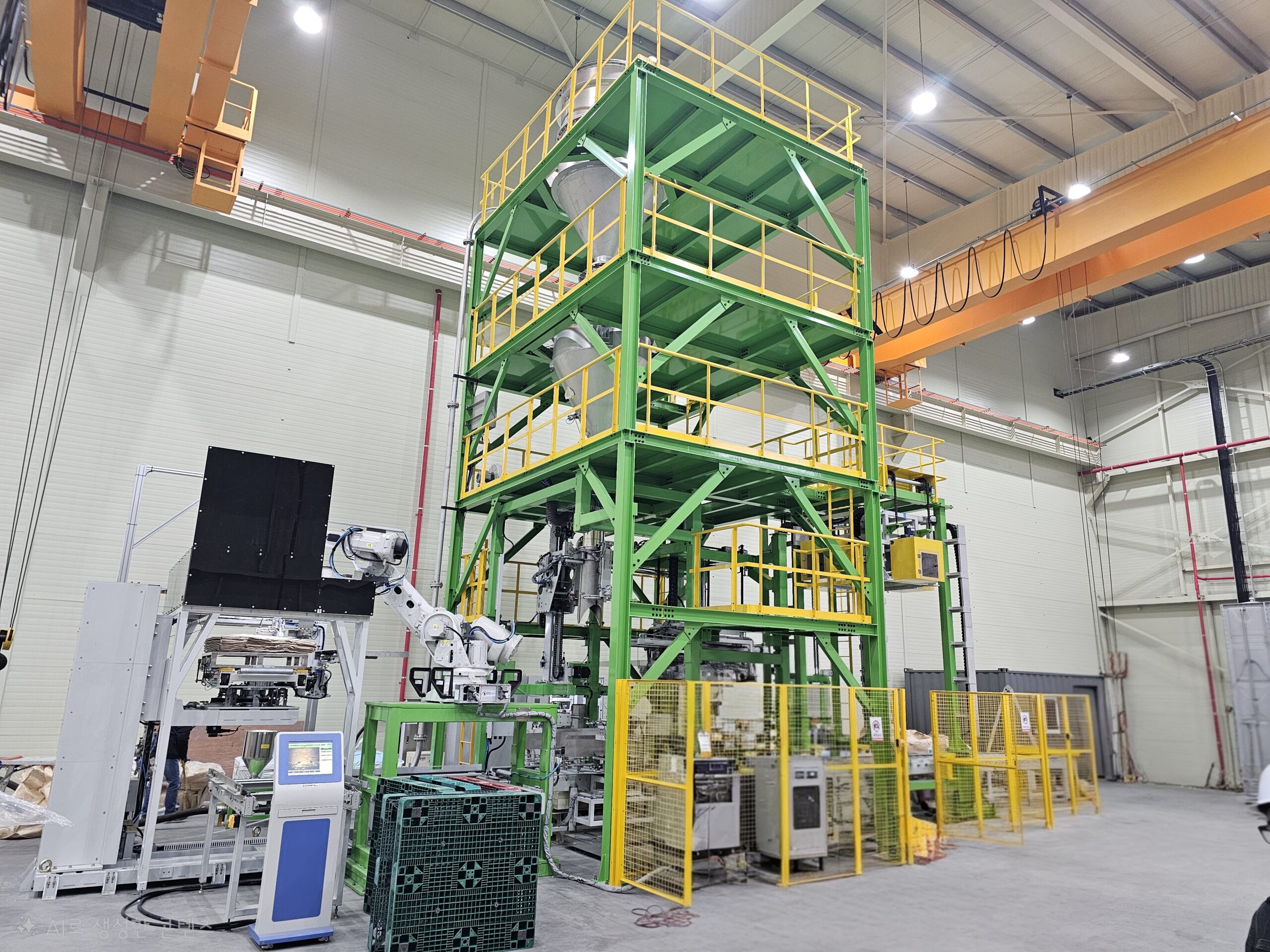
The “ROBAPS” automatic filling system, which our company is now launching, automates the entire process—from filling container bags with powders or pellets to tying them shut.
This system makes it possible to reduce the number of workers required on conventional filling production lines.Furthermore, this product is compatible with existing container bags and can fill 30 to 90 bags per hour. Since existing equipment, such as weighing hoppers, can be utilized as-is, it is easy to integrate into existing production lines, thereby reducing the burden associated with equipment upgrades.
It addresses the chronic labor shortage in dust-prone work environments while contributing to the creation of a safe and healthy work environment for workers and improving operational efficiency.
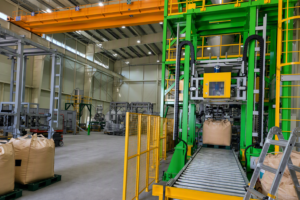
Image of the “ROBAPS” Automatic Filling System in Operation
Benefits of Implementing the “ROBAPS” Automatic Filling System
- Reducing the physical strain on workers who handle heavy loads
- Reducing dust exposure, such as through inhalation or contact with the skin or clothing
- Labor Savings Through Automation of Filling Operations
- Improving Work Efficiency Through the Automation of Filling Operations
- Ensuring Consistent Filling Quality
◇Improving Operational Efficiency Through the Introduction of Automatic Filling Machines (Reference)
[Before Implementation]
3–5 workers assigned to filling operations on one line × 3 shifts = 9–15 workers per day engaged in filling operations
[After Implementation]
With the introduction of the “ROBAPS” automated filling system, filling operations can be performed with 1.5 workers × 3 shifts → 4.5 workers per day
[Expected Benefits]
Reduction of 4.5–10.5 workers per line per day
Overview of the "ROBAPS" Automatic Filling System
| Item | Supported Specifications |
| Packaging Format | Pallet (sack) |
| Bag Shape | Round or Square |
| Suspension Configuration | No restrictions |
| Inner Bag Included? | Either is acceptable (the inner bag must be secured) |
| Inlet Diameter | up to Φ500 mm |
| Bundling (Inner Bag) | Flat Seal |
| Binding (Filling Port) | Automatic Bundling with Insulock |
| Contents | Pellets or Powder |
| Capacity | 30–90 bags per hour |
Product Lineup:
• Manual: Only the container bag setup is automated using a robotic arm; filling and subsequent steps are performed manually
• Semi-automatic: Container bag setup and filling are automated using a robotic arm; strapping is performed manually
• Fully automatic: The entire process, from container bag setup to strapping, is automated using a robotic arm
Future Developments
We will continue to propose automated filling systems primarily to manufacturers that handle powders such as resins, chemicals, and ceramic raw materials. By providing solutions that combine flexible container bags with automated filling systems, we will contribute to improving productivity and ensuring a safe working environment.We aim to achieve sales of 1 billion yen by fiscal year 2028 and are committed to promoting automation in the field of powder logistics.
About Taiyo Kogyo's Logistics Business
In 1963, Taiyo Kogyo successfully developed flexible container bags suitable for the logistics of powders and granules—such as synthetic resins, chemicals, food products, and fertilizers—and launched its logistics business.Initially used for transporting animal feed, their applications gradually expanded to include synthetic resins, chemicals, and food products, and the company has remained a leader in the bulk bag market to this day. In addition to manufacturing, the company’s strength lies in its reusable “running-type” bags, which are cleaned and maintained for repeated use; these are widely utilized in Japan as a logistics system with a low environmental impact.
About Taiyo Kogyo Corporation
Taiyo Kogyo is a leading company in the field of large-scale membrane structures, with a history spanning over 100 years. At the 1970 Japan World Exposition, the company achieved a world first by constructing a low-rise (height-restricted) pneumatic membrane structure for the U.S. Pavilion, in which the roof was supported solely by air pressure.Since then, the company has participated in large-scale projects around the world, including the construction of the membrane roof for the Tokyo Dome and the Millennium Dome in London (now known as The O2 Arena), one of the world’s largest dome structures. Furthermore, for the 2025 Osaka-Kansai World Expo, the company handled the design and construction of more than 20 pavilions, playing a key role in the creation of the Expo site. With membrane structure technology—which excels in cost-effectiveness, constructability, light transmission, and design—at the core of our operations, we have expanded our business from architectural projects such as sports and transportation facilities into the fields of civil engineering, logistics, and the environment, thereby supporting safety and peace of mind in society.
Together with group companies such as TSP Taiyo Co., Ltd., which provides event consulting, and Actio Co., Ltd., which manages facility operations, we are committed to providing new value to society under the motto, “Softening the World. Warming the Future.” https://www.taiyokogyo.co.jp/